
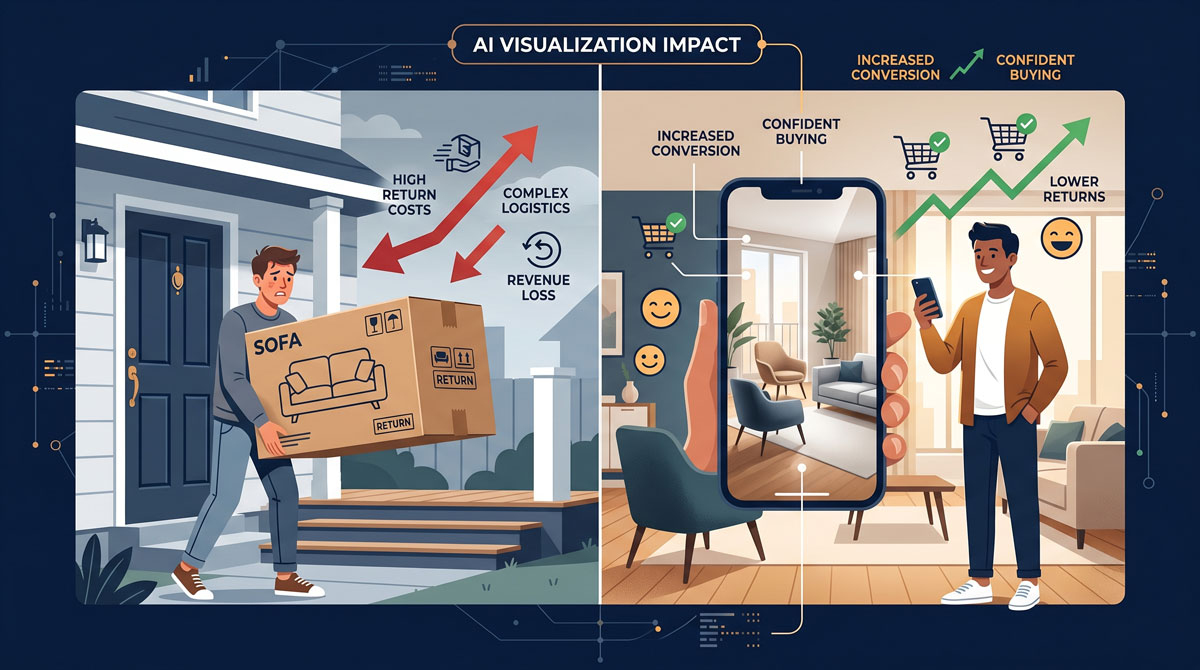
Furniture ecommerce conversion rates sit below 2% for most retailers. A shopper can spend 40 minutes on your product page, add to cart, and still abandon because they cannot know whether the piece they love will actually work in their room. AI visualization changes that dynamic.
The furniture ecommerce confidence gap
While the broader ecommerce industry averages 2.5–3% conversion rates, online furniture and home goods sit at just 1.2–1.6%. The gap is not price or shipping - it is uncertainty. Shoppers cannot know how a piece will look in their specific room until it arrives. AI visualization is the first tool that closes this gap directly on the product page.
The Core Problem in Furniture Ecommerce
Furniture shoppers are not worried about whether the product is what it says it is. They are worried about whether it will look right in their specific room. This is a unique verification challenge that no standard ecommerce feature set addresses.
Shoppers cannot visualize to scale
A 90-inch sofa on a product page looks proportionate because the photo was taken in a large, open space. Shoppers routinely underestimate scale and order pieces that overwhelm their room.
Color looks different at home
Product photography is color-corrected for neutral light and optimal presentation. Your customer's apartment may have north-facing windows, warm yellow overhead lighting, or dark wood floors. The color that reads beautifully on the product page reads completely differently in their room.
Style fit with existing furniture is invisible
Whether a sofa looks right next to a customer's existing coffee table, rug, and media stand is information that no product photo can provide. The shopper has to guess.
Returns are uniquely expensive for furniture
Furniture returns require freight logistics, not postal return labels. The average furniture return costs $50–$200 to process. For high-ticket items, return rates above 5% represent a significant erosion of margin.
What AI Visualization Does
AI visualization lets shoppers upload a photo of their own room and see your specific product placed realistically in that space before they buy.
Uses the shopper's actual room
Not a generic staged room. Not a generic living room template. The shopper's specific walls, floors, ceiling height, natural light, and existing furniture - exactly as they are.
Uses your existing product photography
No 3D models, no new photography studio, no CGI budget. The AI uses the product images that are already on your product pages. The implementation cost is dramatically lower than traditional visualization methods.
Generates a photorealistic result
The AI matches the product to the room's lighting conditions, places it at the correct perspective, and generates a composite that looks like a real photo of the room with the product in place.
Works without an app
The entire flow is browser-based. Shoppers do not need to download an app. The button is on your product page; the experience happens in the same session, on desktop or mobile.
The Business Case
Higher conversion at the product page decision point
Shoppers who resolve their uncertainty before leaving the product page are significantly more likely to buy. Furniture retailer DFS reported a 112% conversion lift after adding sofa visualization. When a shopper can see that a piece fits their space and matches their wall color, the primary barrier to checkout is removed.
Lower return rates on visualized products
The online furniture return rate averages 22.7%, with size/space mismatch and color mismatch as the leading causes. Processing a bulky furniture return costs an estimated $55–$108 per item, easily eroding the profit margin of the original sale. Shopify data indicates that products with AR/visualization content see return rates fall by up to 40%.
Competitive differentiation without catalog cost
Historically, room visualization was a moat built by retailers like IKEA and Wayfair, who could fund large 3D modeling budgets. Photo-based AI visualization levels the playing field. Independent retailers and DTC brands can now offer the same capability using their existing product photography - no 3D assets, no massive development project.
Higher average order values from confident buyers
Shoppers who visualize often discover that they want additional pieces to complete the look they are seeing. A room image showing one sofa may prompt consideration of a rug, coffee table, or accent chair that completes the composition - increasing basket size within the same session.
AI Visualization vs. AR and 3D Modeling
Traditional 3D modeling
Requires commissioning 3D models for every product. Average cost: $200–$800 per SKU. For a catalog of 500 products, this is $100,000–$400,000 before any display logic. Ongoing cost for new products is significant.
Setup cost: Very high. Ongoing cost: High. Requirement: New 3D asset per SKU.
Retailer AR apps
Requires 3D model library and a bespoke AR app. App download friction significantly reduces the percentage of shoppers who engage. Requires ongoing app maintenance and updates.
Setup cost: Very high. Ongoing cost: High. Shopper friction: App download required.
AI visualization (DecorViz)
Uses existing product photography. No 3D models needed. Browser-based, no app required. Installs on Shopify without code changes. Scales to full catalog without per-SKU asset work.
Setup cost: Low. Ongoing cost: Low. Shopper friction: Two uploads, browser-based.
Which Stores Benefit Most
AI visualization delivers value across all furniture ecommerce, but certain store profiles see the most immediate impact:
Online-only furniture retailers
Stores without physical showrooms carry the entire burden of converting browsers to buyers on screen. Visualization replaces the showroom experience - it is the closest thing to touching and seeing a piece in person that ecommerce can currently offer.
DTC furniture brands
DTC brands competing against established omnichannel retailers need to build trust quickly. Letting a shopper see your product in their actual room before buying - next to the furniture they already own - builds the kind of confidence that turns a first-time visitor into a buyer.
Stores with high return rates
If your return data shows a high volume of "too large for the space" or "color looked different" reasons, visualization directly attacks the root cause. Each of those return types is a pre-purchase visualization failure.
High-AOV categories
Shoppers hesitate most on expensive items - sofas, sectionals, dining tables, beds. The higher the price, the more uncertainty costs you in abandoned carts. Visualization pays for itself most quickly in these categories.
Getting Started
For furniture retailers ready to evaluate AI visualization, the practical starting point is a product category pilot.
Choose your highest-hesitation category
Sofas, sectionals, and area rugs typically generate the most purchase hesitation. Start the pilot with the category where visualization is most likely to resolve uncertainty.
Review the integration options
The DecorViz Storefront page covers button placement, shopper flow, platform compatibility, and pricing. For Shopify, the integration requires no code changes.
Enable on 5–10 products and measure
Track conversion rate and return rate on visualized products versus the same products without the button. The comparison gives you a reliable indication of impact before a full rollout.
Add AI visualization to your product pages
No 3D models needed. Works with your existing product photography.
FAQ
What is AI product visualization for furniture retailers?
AI product visualization lets shoppers upload a photo of their own room and see a specific furniture product placed realistically into that space before they buy. The AI uses the retailer's existing product photography - no 3D models are required - and generates a photorealistic composite.
How does AI visualization reduce furniture returns?
The most common driver of furniture returns is the gap between expectations and reality. AI visualization closes that gap before the purchase. Shoppers who have seen the product in their actual room before ordering have significantly lower rates of "expected it to look different" returns.
Is AI visualization expensive to implement?
Compared to traditional visualization methods (3D model production, AR app development), AI visualization has a dramatically lower implementation cost. DecorViz Storefront requires no 3D model commissioning, uses your existing product photography, and for Shopify retailers requires no development work.
Is this different from what Wayfair and IKEA offer?
Yes. Wayfair's View in Room and IKEA Place are retailer-specific AR tools that require 3D models and work only on mobile via their own apps. DecorViz is a browser-based, photo-based AI tool that any furniture retailer can add to their own product pages using their existing photography.
For implementation detail, see how to add a "See in Your Room" button to product pages. For the return reduction angle specifically, read how furniture stores can reduce returns. For the brand relationship beyond conversion, explore home decor product page engagement that ads cannot buy.