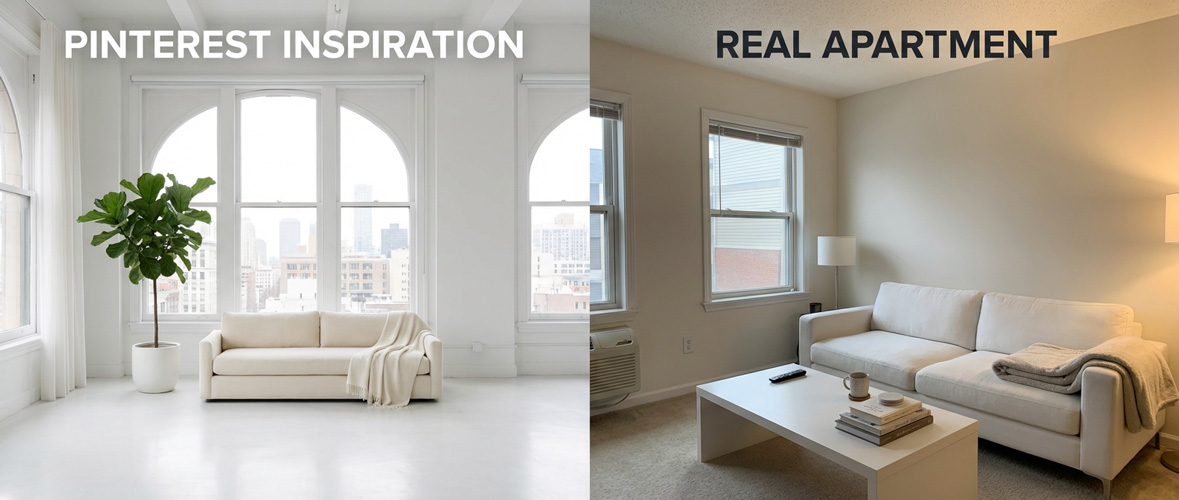
Pinterest is full of beautiful, aspirational rooms. Clean, calm, perfectly balanced. But when people try to recreate these looks in their own apartments, the result often feels disappointing. This is because Pinterest rooms are not designed to be lived in; they are designed to be photographed.
This is Normal: The Inspiration Gap
The gap between inspiration and reality is not a failure of your taste. It's a failure of context. The five factors below explain why your real room can never perfectly match a staged photo.
1. Staged vs. Lived-In: The Illusion of Perfection
Most Pinterest interiors are styled for one purpose: the image. This means furniture is arranged for composition, not comfort or daily use.
Temporary Accessories
The perfect throw blanket or stack of books is temporary. In real life, these items are quickly replaced by remote controls, charging cables, and mail.
Zero Clutter
Staged rooms have zero clutter. Real apartments have things like pet toys, shoes, and half-finished projects that break the "minimalist" illusion.
Composition Over Comfort
A sofa might be pushed against a wall for a better photo angle, even if that makes it less comfortable to sit on.
2. The Space Illusion: Real Apartments Are Smaller
Many Pinterest photos are taken in large homes, lofts, or studio sets. Professional photographers use wide-angle lenses and clever framing to exaggerate space and make furniture appear lighter.
In real apartments, furniture sits closer together, ceilings are lower, and the visual mass of a piece adds up quickly, making the room feel cramped even if the measurements are technically correct.
3. The Lighting Trick: Controlled vs. Chaotic
Pinterest rooms use professional lighting or carefully controlled daylight. Shadows are softened, and colors are balanced to perfection.
At home, you have chaotic lighting: mixed bulbs, different color temperatures, and natural light that changes hourly. This is the number one reason a color or material you loved online looks completely different in your space.
4. The Set Problem: Everything is Chosen as a Complete Set
Most inspiration rooms use furniture selected together: same undertones, materials, and proportions. They are a curated collection.
In real life, you are mixing a sofa from one store, a rug from another, and a lamp you already owned. That mix is where style problems start, as the pieces were never intended to live together.
5. The Biggest Missing Piece: Your Room's Context
Pinterest shows you what looks good somewhere. It doesn't show you what looks good in your space.
Your existing wall color, floor tone, and the view outside your window all create a unique context. Any new piece of furniture must harmonize with this context to look right.
How to Adapt Pinterest Inspiration (The Actionable Guide)
Stop trying to copy the image. Start trying to extract the idea behind the image.
The Inspiration Translation Cheat Sheet
Instead of copying exactly, extract these core elements:
- Mood: Is it cozy, minimal, warm, or modern?
- Color Palette: Identify the 3 main colors and 1 accent color.
- Materials: Is the dominant material light wood, dark metal, textured fabric, or leather?
- Proportions: Are the pieces low-slung and deep, or tall and narrow?
Then, find pieces that match those qualities and use a visualization tool to test them in your real room.
Extract the Idea, Not the Item
Focus on the mood and the feeling the room evokes, not the specific brand or product.
Compare to Your Reality
Hold the inspiration photo next to a photo of your room. Ask: What's different? (Light, size, colors, ceiling height).
Preview in Your Actual Space
Visual confirmation beats imagination every time. Use a realistic visualization tool to see if your chosen piece harmonizes with your room's unique context.
Ready to test inspiration in your own room?
See how furniture actually fits your space before committing to a purchase based on a staged photo.
Learn practical ways to visualize furniture in your own room before making a purchase.
FAQ
Why does my room never look like Pinterest?
Because Pinterest rooms are staged, professionally lit, and often larger than real apartments. They lack the "clutter" and chaotic lighting of a lived-in space.
Is Pinterest still useful for interior design?
Yes, if you use it for inspiration and mood-boarding, not exact replication. Focus on extracting the core style elements.
What's the best way to adapt Pinterest ideas?
Extract the mood and color palette, then use a realistic visualization tool to test pieces that match those elements in your actual room's context.
For insights on why furniture looks different at home versus in stores, see our guide on why furniture looks different at home
Pinterest isn't lying to you. It's just showing rooms that were never meant to be real.